
 EN
EN  NL
NL FR
FR DE
DE HI
HI IT
IT KO
KO PL
PL PT
PT RU
RU ES
ES TR
TR AR
AR BG
BG HR
HR CS
CS DA
DA FI
FI EL
EL JA
JA NO
NO RO
RO SV
SV IW
IW ID
ID LV
LV LT
LT SR
SR SK
SK SL
SL UK
UK VI
VI ET
ET HU
HU UZ
UZ TH
TH FA
FA MS
MS BE
BE HY
HY AZ
AZ KA
KA MN
MN MY
MY KK
KK TG
TGGrinding fine powders can become difficult when ordinary milling methods are too slow or cannot reach the required particle size. A dual planetary ball mill is designed for this kind of demanding work. It combines the rotation of the grinding jars with the rotation of the supporting disc, creating strong impact and friction inside the jars. This repeated movement helps break down materials quickly and can produce very fine powders. From battery materials and ceramics to metals and laboratory samples, understanding how the mill works makes it easier to choose suitable settings, grinding media, and processing time for each material.
What Makes a Dual Planetary Ball Mill Different
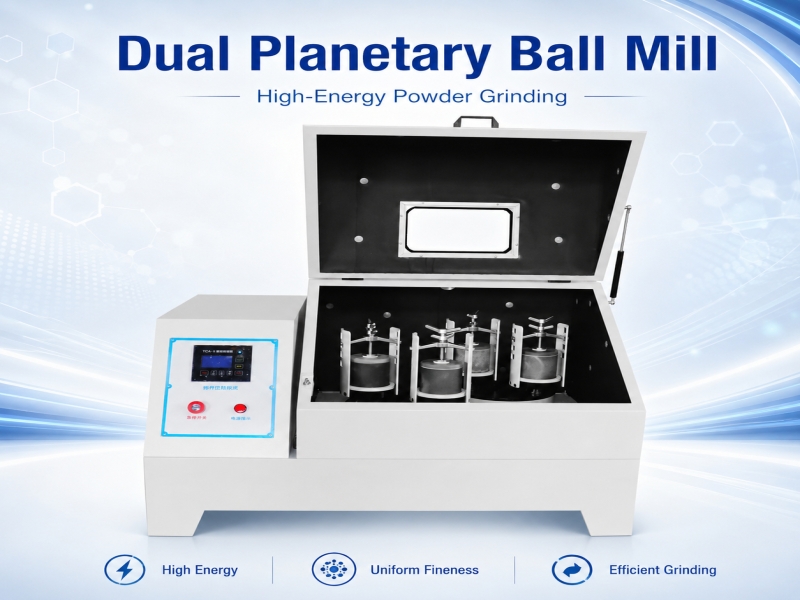
A dual planetary ball mill stands out because it creates several types of movement at the same time. The grinding jars rotate around their own axes while also moving around the central axis of the machine. Inside each jar, the grinding balls are pushed, lifted, and thrown against the material as the jars move. This creates strong impact and friction, which helps reduce particle size much faster than simple ball milling.
The word “dual” is important because the machine can work with two grinding jars at once. This gives the operator a practical way to process two samples under similar conditions or increase the amount of material processed in one cycle. For example, a laboratory working with ceramic powders might test two different formulations at the same speed and grinding time.
Another difference is the level of energy delivered to the powder. The combined movement can produce much stronger grinding action than a basic rotating mill. This makes a dual planetary ball mill useful when the goal is not only to make smaller particles but also to improve mixing, dispersion, or mechanical alloying.
The grinding result still depends on how the machine is set up. Jar size, ball material, ball-to-powder ratio, rotation speed, grinding time, and the properties of the sample all matter. A harder material may need stronger grinding conditions, while a softer or heat-sensitive powder may require a lower speed or shorter cycle.
For practical work, avoid starting with the most aggressive setting. Begin with a moderate speed and a short grinding period, check the powder, and adjust from there. This approach helps prevent unnecessary heating, contamination, or excessive wear on the grinding equipment.
How Dual Planetary Motion Improves Grinding Energy
The main advantage of dual planetary motion is the way it increases the movement of the grinding balls inside the jar. As each jar rotates around its own axis and also travels around the central axis, the balls are exposed to repeated changes in speed and direction. They are lifted along the jar wall and then released, creating strong impacts when they fall or move across the powder bed. At the same time, friction between the balls and powder adds another grinding force.
This combination gives the powder more chances to break apart during each cycle. Instead of relying mainly on simple rolling or falling action, the material experiences repeated impact, compression, and rubbing. This is especially useful for hard materials that are difficult to reduce with conventional milling equipment.
For example, a laboratory processing a ceramic powder may start with relatively coarse particles that do not respond well to ordinary mixing. With suitable ball size, speed, and grinding time, the stronger motion of a dual planetary mill can help produce a much finer and more evenly mixed powder.
However, more energy does not always mean a better result. Running the mill at very high speed for too long can raise the temperature inside the jars. Some powders may also stick to the jar walls or grinding balls when excessive energy is applied. Heat-sensitive materials can be affected as well.
A practical approach is to treat grinding energy as something that needs to be balanced. Start with a moderate speed, choose a suitable ball-to-powder ratio, and check the sample after a short cycle. If the particles are still too large, increase the grinding time or adjust the speed gradually. This makes it easier to find an effective setting without wasting energy or damaging the material.
Suitable Materials for Dual Planetary Ball Mill Processing

A dual planetary ball mill can process many types of materials, but the best results depend on the material's hardness, moisture, heat sensitivity, and required final particle size. It is commonly used for powders that need fine grinding, strong mixing, or mechanical treatment.
Hard materials such as ceramics, minerals, glass, and some metal compounds are good candidates because the strong impact from the grinding balls can break them into smaller particles. Battery research also uses planetary milling for materials such as lithium-based compounds, graphite, and other electrode powders. In these applications, careful control of grinding conditions is important because excessive heat or contamination can affect the final material.
The mill can also handle softer materials, including certain chemical powders and pigments, when the right grinding media and speed are selected. For example, a laboratory developing a ceramic coating may use the mill to mix several dry powders and reduce larger particles at the same time. The result can be a more uniform starting material for later processing.
Material moisture is another point to check. Wet or sticky powders may behave differently from dry powders and can attach to the jar or balls. If the material is sensitive to moisture, the grinding process may need sealed jars or a controlled atmosphere.
Before starting a batch, check whether the material is compatible with the jar and grinding media. Steel balls can introduce metal contamination into some sensitive samples, while ceramic or other specialized media may be a better choice. Also consider whether the material can withstand the heat generated during high-energy grinding.
A simple trial batch is often the safest way to find suitable conditions. Start with a small amount, moderate speed, and a short cycle. Examine the powder before increasing the grinding intensity or processing time.
Mill Jar Selection for High-Energy Powder Grinding
Choosing the right mill jar is an important part of high-energy powder grinding. The jar is more than a container for the sample. Its material, size, shape, and internal condition affect how energy is transferred to the powder and grinding balls. A poor match can lead to contamination, excessive wear, overheating, or uneven grinding.
Start by looking at the material being processed. Stainless steel jars are commonly used for general-purpose grinding and can handle demanding applications. However, steel may add unwanted metal particles to sensitive samples. For ceramic, electronic, or high-purity materials, jars made from materials such as zirconia or alumina can be a better choice because they can reduce the risk of metal contamination.
Jar volume also needs attention. A jar that is too large for a small powder batch may not provide efficient movement of the grinding balls. On the other hand, filling the jar too heavily can restrict ball movement and reduce grinding efficiency. Leave enough free space for the balls and powder to move during operation.
The grinding media should match the jar as well. Using balls and jars made from compatible materials helps reduce unwanted wear. For example, using ceramic balls inside a ceramic jar can be useful when keeping metal contamination low is a priority.
For a real laboratory example, imagine a team preparing a fine ceramic powder for a battery research project. They may choose a zirconia jar with zirconia balls instead of steel equipment to keep the sample cleaner. If the same team is processing a less sensitive mineral sample, a stainless steel setup may be more practical and economical.
Before each run, inspect the jar for cracks, deep scratches, worn surfaces, or damaged sealing parts. Clean it carefully and make sure the lid is properly secured. A suitable jar, combined with the right ball size and filling level, gives the mill a much better chance of producing consistent high-energy grinding results.
Common Applications in Nano Powder Preparation

Dual planetary roll ball mill are often used in early-stage research and small-scale production when a material needs to be reduced to a very fine powder. Their strong impact and friction can help break down particles and improve mixing, making them useful for preparing materials for further testing or processing. The final particle size depends on the starting material, grinding media, speed, grinding time, and other process conditions, so reaching the nanoscale is not guaranteed in every application.
One common area is battery material research. Researchers may mill electrode powders to improve particle size and mixing before making test cells. For example, a laboratory working on a new cathode formulation may use planetary milling to combine several raw powders into a more uniform mixture. The milling step can also help reduce larger particles before the material moves to the next production stage.
Ceramics are another important application. Fine ceramic powders are used for coatings, electronic components, structural ceramics, and other products. A dual planetary mill can help break down agglomerates and create a more consistent powder mixture. Better mixing can make later pressing, sintering, or coating steps easier to control.
The process is also used in nanocomposite research. Different powders can be milled together so that their particles are distributed more evenly. In some cases, mechanical milling can change the structure of the material, which is useful when researchers are studying new material properties.
When preparing very fine powders, temperature control becomes especially important. High-energy grinding can generate heat, and some materials may react, oxidize, or change when exposed to excessive temperature. Short grinding cycles with cooling intervals can help manage this problem.
Check the particle size after every test instead of just grinding longer. Longer grinding doesn't always mean better results. If the size isn't right, look at the ball size, the ratio of balls to powder, the jar material, and the milling speed. Adjust these before running the machine longer.

Changsha Tianchuang(TENCAN) Powder Technology Co., Ltd., established in 2006, is an integrated enterprise specializing in R&D, manufacturing, and sales. Its R&D, sales, and operations center is located in the Changsha Economic and Technological Development Zone, while its production base is in the Wushi High-tech Industrial Park.


