
 EN
EN  NL
NL FR
FR DE
DE HI
HI IT
IT KO
KO PL
PL PT
PT RU
RU ES
ES TR
TR AR
AR BG
BG HR
HR CS
CS DA
DA FI
FI EL
EL JA
JA NO
NO RO
RO SV
SV IW
IW ID
ID LV
LV LT
LT SR
SR SK
SK SL
SL UK
UK VI
VI ET
ET HU
HU UZ
UZ TH
TH FA
FA MS
MS BE
BE HY
HY AZ
AZ KA
KA MN
MN MY
MY KK
KK TG
TGMoving from batch powder grinding to continuous processing can make a big difference when production demand starts to grow. A batch planetary ball mill works well when you need to process a fixed amount of material, test a new formula, or adjust grinding conditions between runs. But when the same powder must be processed again and again, loading and unloading each batch can take extra time and labor. A continuous planetary ball mill offers another approach by allowing fresh material to enter while processed powder leaves the system. This guide explains how the transition works, what to check before changing your process, and how to avoid common operating problems.
How a Continuous Planetary Ball Mill Improves Processing Efficiency

A continuous planetary ball mill can improve processing efficiency by keeping material moving through the grinding system instead of stopping after every batch. In a traditional batch setup, operators need to load the mill, run the grinding cycle, stop the machine, collect the powder, and prepare it for the next run. Repeating these steps throughout a production day can add up to a lot of lost time. With continuous operation, fresh powder can be fed into the mill while finished material is discharged at a controlled rate. For example, a plant producing ceramic powder may need the same particle size for several hours of production. A continuous system can reduce repeated handling and help maintain a steadier production flow. The key is to match the feed rate, grinding speed, media size, and residence time so the material receives enough energy before leaving the mill. Operators should also monitor temperature and particle size during operation, since running continuously can change heat buildup and grinding conditions compared with batch processing.
Difference Between Batch Grinding and Continuous Grinding
Batch grinding and continuous grinding use the same basic idea grinding powder with milling media but they handle material in different ways. In batch grinding, a set amount of powder is loaded into the mill and processed for a selected time. Once the cycle is finished, the machine is stopped and the powder is removed. This approach is useful for laboratory testing, small production runs, and products that need different grinding conditions from one batch to another. Continuous grinding keeps material moving through the mill. New feed enters while processed powder leaves, which makes it better suited to longer production runs.
The main difference is workflow. Batch grinding gives operators more control over each individual lot. If a ceramic manufacturer wants to test three different formulations, for example, each formula can be ground separately and checked before moving to the next one. Continuous grinding is more focused on steady output. A battery-material producer making the same powder throughout the day may benefit from avoiding repeated loading and unloading.
There are also differences in process control. With batch grinding, grinding time is easy to set because the material stays inside the chamber for a defined period. With continuous grinding, residence time depends on factors such as feed rate, chamber volume, material flow, and operating conditions. A faster feed rate may shorten the time available for grinding, while a slower rate can increase residence time.
When choosing between the two, start with the production goal rather than simply choosing the newer method. Use batch grinding when flexibility, testing, and small quantities are priorities. Consider continuous grinding when demand is steady and reducing handling time is important. Before making the switch, run trials and compare particle size, temperature, energy use, output rate, and product consistency.
Material Feeding and Discharging in Continuous Planetary Ball Mills
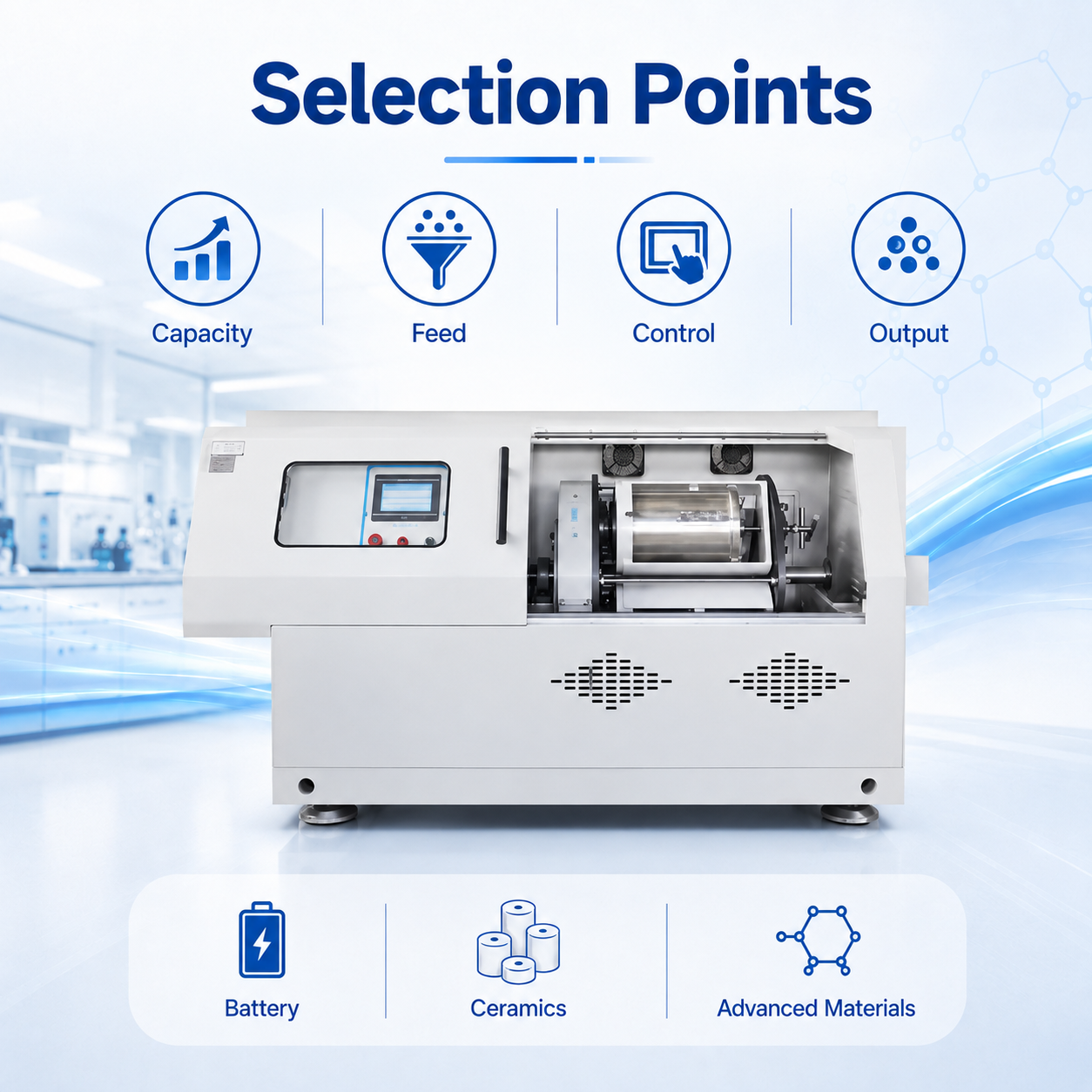
Material feeding and discharging are two of the most important parts of a continuous planetary ball milling machine . Unlike batch grinding, where powder is loaded and removed after a cycle, a continuous system needs a steady material flow throughout operation. Start by checking the feed material carefully. Large lumps, excess moisture, or inconsistent feed size can make the grinding process less stable. A feeder should deliver material at a controlled rate rather than sending large amounts into the mill at once. For example, if a ceramic powder line suddenly increases the feed rate, the material may not spend enough time inside the grinding zone to reach the required particle size.
Inside the mill, grinding conditions depend partly on how quickly material moves through the chamber. The feed rate, chamber design, media loading, and operating speed all work together to determine residence time. Operators should make small adjustments and watch the particle size instead of making large changes all at once.
The discharge side needs the same level of attention. Finished powder should leave the system at a steady rate without allowing material to build up inside the equipment. A blocked or restricted discharge can change the material residence time and may increase temperature or affect product quality. For fine powders, the discharge system should also be designed to limit dust loss and prevent unwanted contamination.
Before running continuously, test the feeding and discharge system with a small amount of material. Check whether the powder moves smoothly, whether the feed rate remains stable, and whether the discharged material meets the target particle size. Once the flow is stable, record the main settings so operators can repeat the same conditions during future production runs.
Key Parameters for Stable Continuous Powder Grinding
Stable continuous powder grinding depends on keeping several operating conditions under control at the same time. The first parameter to check is the feed rate. If material enters too quickly, it may not receive enough grinding action before leaving the mill. If the feed is too slow, production may drop and the material may stay in the grinding zone longer than needed. Start with a moderate feed rate and adjust it based on particle size and output.
Mill speed is another important setting. Higher speed can increase grinding energy, but excessive speed may also raise temperature, increase wear, or create unwanted changes in the powder. The best setting depends on the material and the required result, so avoid assuming that maximum speed will always give better grinding.
Grinding media size and loading also affect the final powder. Smaller media can be useful for fine grinding, while larger media can provide stronger impact for coarser particles. Keep the media level consistent between production runs to make process results easier to repeat.
Residence time should also be monitored. In continuous operation, powder needs enough time inside the mill to reach the target particle size. Feed rate and internal flow both affect this time. If the powder leaves too quickly, reduce the feed rate or review the process settings.
Temperature is another practical point. Continuous operation can generate heat, especially during high-energy grinding. If the material is sensitive to heat, monitor the mill temperature and use suitable cooling when needed.
Finally, check particle size and product consistency at regular intervals. A simple sampling routine can reveal changes before they become a larger production problem. Keep records of feed rate, speed, temperature, media condition, and particle size. Over time, these records make it easier to find a stable operating range and repeat good results.
When to Choose Continuous Planetary Ball Mill Equipment

A continuous planetary ball mill laboratory equipment is worth considering when powder processing has moved beyond occasional batches and needs a steady production flow. The biggest question is not simply how much powder you need to make, but how often the process must run and how consistent the material needs to be. If operators are repeatedly loading, stopping, emptying, and cleaning a batch mill, a continuous setup may reduce these interruptions.
For example, imagine a ceramic parts manufacturer producing the same fine powder every working day. With batch grinding, several cycles may be needed to reach the daily target. Each cycle requires material handling and process checks. A continuous system can keep the material moving through the grinding process, making it a practical option when demand is stable.
Continuous equipment can also make sense when particle size needs to remain consistent over long production periods. However, it is not automatically the best choice for every application. If your production involves small quantities, frequent formula changes, or many different materials, batch grinding may provide more flexibility. A laboratory that tests several powder formulations each week, for instance, may find batch processing easier to manage.
Before picking any equipment, think about your real production needs. Look at how much you need to produce, the desired particle size, and the material's characteristics. Check moisture content, sensitivity to heat, and how long the machine will run. Also, plan how the powder will enter and leave the system.
A good starting point is to compare your current batch process with the expected continuous process. Record how much time is spent loading, unloading, cleaning, and waiting between cycles. Then compare those figures with the output and operating requirements of a continuous system. This simple review can help you decide whether changing from batch to continuous grinding will provide a practical improvement rather than adding unnecessary equipment to the process.
Table of Contents
- How a Continuous Planetary Ball Mill Improves Processing Efficiency
- Difference Between Batch Grinding and Continuous Grinding
- Material Feeding and Discharging in Continuous Planetary Ball Mills
- Key Parameters for Stable Continuous Powder Grinding
- When to Choose Continuous Planetary Ball Mill Equipment

Changsha Tianchuang(TENCAN) Powder Technology Co., Ltd., established in 2006, is an integrated enterprise specializing in R&D, manufacturing, and sales. Its R&D, sales, and operations center is located in the Changsha Economic and Technological Development Zone, while its production base is in the Wushi High-tech Industrial Park.


