
 EN
EN  NL
NL FR
FR DE
DE HI
HI IT
IT KO
KO PL
PL PT
PT RU
RU ES
ES TR
TR AR
AR BG
BG HR
HR CS
CS DA
DA FI
FI EL
EL JA
JA NO
NO RO
RO SV
SV IW
IW ID
ID LV
LV LT
LT SR
SR SK
SK SL
SL UK
UK VI
VI ET
ET HU
HU UZ
UZ TH
TH FA
FA MS
MS BE
BE HY
HY AZ
AZ KA
KA MN
MN MY
MY KK
KK TG
TGWhen processing any high-end materials, one of the biggest problems may be obtaining smooth and homogeneous dispersion. The small particles have a tendency to agglomerate, and this influences the quality of the end-product in terms of its characteristics, efficiency and appearance. A lab horizontal bar-pin nano sand mill & Roll Ball Mill are created to overcome this difficulty through the use of high-speed grinding and mixing process, which allows reducing the particles' sizes significantly. The equipment is commonly applied in various industries including coating, printing ink, pigment, electronics materials and nanomaterials applications. This manual describes the principle of the equipment operation, ways to operate it effectively and factors that influence ultra-fine dispersion efficiency.
Grinding Chamber Design of a Laboratory Horizontal Bar-Pin Nano Sand Mill
The grinding chamber is the core working area of a laboratory horizontal bar-pin nano sand mill. Its design directly affects grinding efficiency, particle size control, and the quality of the final dispersion. A well-designed chamber allows grinding media, materials, and energy to work together smoothly, helping break down larger particles into smaller and more uniform sizes.
A horizontal bar-pin nano sand mill usually has a narrow cylindrical grinding chamber where the material flows continuously while being processed. Inside the chamber, rotating pins create strong impact and shear forces between the grinding media and material. These forces help separate particle groups and reduce particle size during operation. The horizontal structure also supports better material flow compared with some traditional vertical designs, making it easier to achieve consistent dispersion results.
The arrangement of the pins is one of the most important parts of the chamber design. Bar-pin structures create many contact points between the grinding beads and the material. When the rotor spins at high speed, the pins drive the beads into intense movement, creating repeated collisions. For example, when producing a nano pigment dispersion for ink development, uneven particle sizes can cause poor color strength or unstable printing performance. A properly designed pin structure helps create a more uniform pigment distribution.
The gap between the rotor and chamber wall also needs careful control. A smaller and more stable gap increases grinding force but requires precise manufacturing to avoid excessive wear. The chamber materials must also resist abrasion because the grinding beads move at high speed for long periods. Stainless steel, hardened alloys, or ceramic materials are often selected depending on the application.
Cooling design is another key feature of the grinding chamber. Nano dispersion processes can generate heat due to high-speed operation and friction. If the temperature rises too much, some materials may change properties or lose stability. Many laboratory horizontal bar-pin nano sand mills include a cooling jacket around the chamber to help maintain a suitable working temperature.
When selecting or operating this type of mill, pay attention to the chamber volume, pin structure, cooling system, and material compatibility. A suitable chamber design helps researchers achieve reliable test results and provides a better reference when moving from laboratory experiments to larger production processes.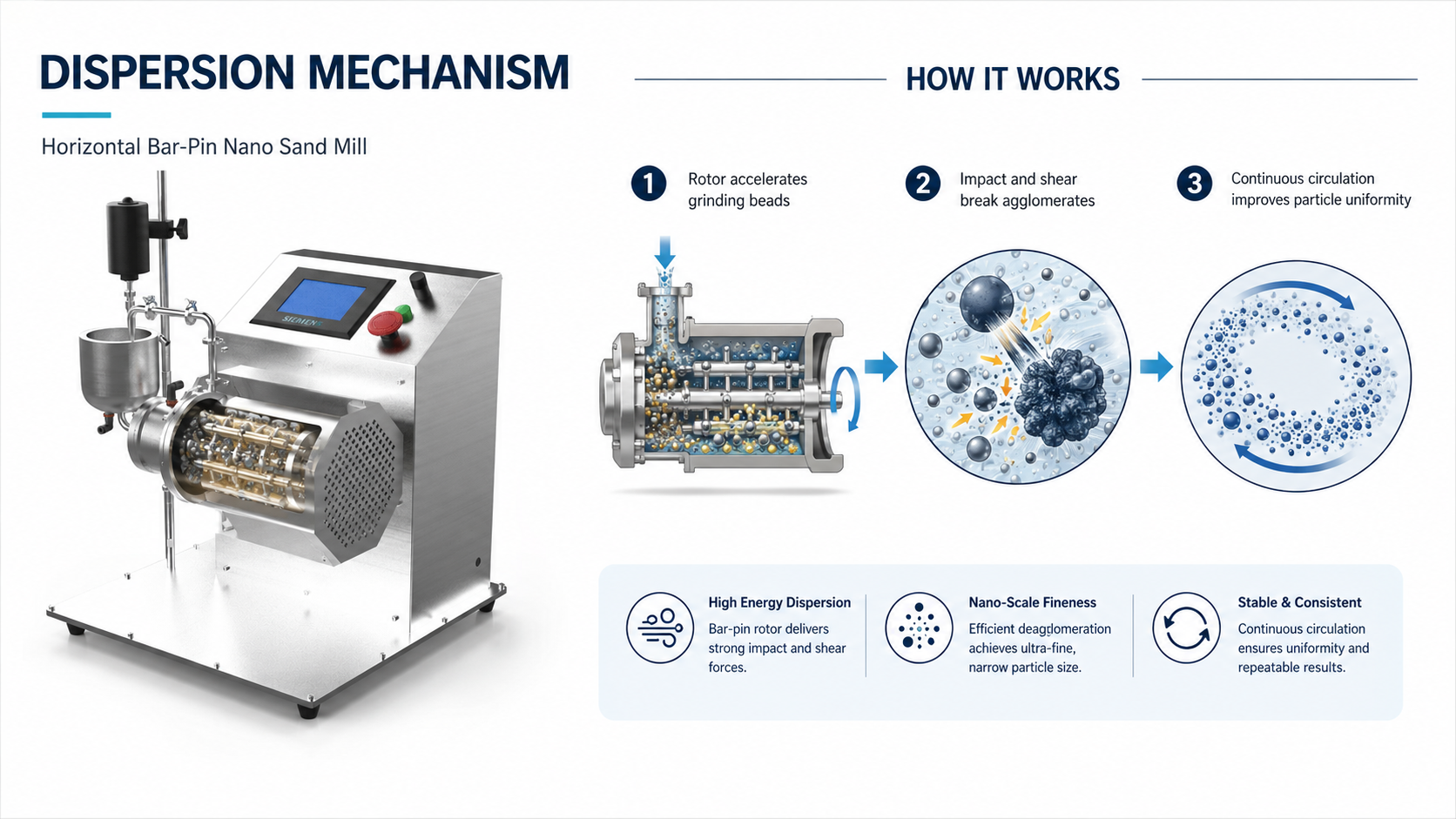
How a Laboratory Horizontal Bar-Pin Nano Sand Mill Handles Solid-Liquid Slurries
A laboratory horizontal bar-pin nano sand mill is designed to process solid-liquid slurries by creating strong mechanical forces that separate particles and improve dispersion quality. A solid-liquid slurry usually contains fine solid particles mixed with a liquid medium, such as pigments in solvents, ceramic powders in water, or active ingredients in chemical solutions. The challenge is to keep these particles evenly distributed and reduce their size without damaging the material.
During operation, the slurry enters the grinding chamber and moves through the space filled with small grinding beads. The high-speed rotating bar-pin rotor pushes the beads into motion, creating repeated impacts and shear forces. These movements break apart particle clusters and help reduce larger particles into a finer and more stable size range.
The flow of the slurry inside the chamber plays an important role in the grinding process. As the material passes through the active grinding area, every part of the slurry has a chance to contact the moving beads. This continuous circulation helps avoid uneven processing, where some particles become over-ground while others remain too large.
For example, when producing a nano coating material, the raw slurry may contain pigment particles that are not evenly distributed. If these particles remain in groups, the coating may show color differences, rough surfaces, or poor performance after application. A horizontal bar-pin nano sand mill helps break these groups apart and creates a smoother mixture suitable for testing and production.
The viscosity of the slurry is another factor that affects performance. A slurry that is too thick may move slowly through the chamber, reducing grinding efficiency. A slurry that is too thin may not provide enough interaction between particles and grinding media. Adjusting the solid content, liquid type, and flow speed helps achieve better results.
Temperature control is also important when handling sensitive materials. The friction created during high-speed grinding can increase heat, which may affect certain chemicals, polymers, or biological materials. Using a cooling system around the grinding chamber helps keep the slurry within a suitable temperature range.
For laboratory testing, operators should first check the particle size, viscosity, and material characteristics of the slurry. Starting with moderate speed and adjusting parameters step by step makes it easier to find the best grinding conditions. This approach helps researchers understand how the material responds and provides useful data for future scale-up production.
Laboratory Horizontal Bar-Pin Nano Sand Mill Applications in Battery Materials
A laboratory horizontal bar-pin nano sand mill plays an important role in the research and development of advanced battery materials. As battery technology continues to improve, manufacturers need materials with smaller particle sizes, better dispersion, and more stable performance. The nano sand mill helps researchers process battery slurries by improving the mixing and grinding quality of active materials, conductive additives, and other components.
In lithium-ion battery development, many materials need to be evenly distributed before they can be used for electrode production. For example, cathode materials such as lithium iron phosphate (LFP), lithium cobalt oxide (LCO), and nickel-based materials often require fine particle control to improve battery performance. When particles are too large or unevenly mixed, the electrode may have poor conductivity, uneven charging behavior, or reduced cycle life.
The bar-pin structure inside the nano sand mill creates strong shear and impact forces during operation. These forces help break particle clusters and improve the contact between solid materials and liquid binders. For battery slurry preparation, this creates a smoother mixture that can be coated more evenly onto electrode foils.
A common example is the preparation of conductive carbon slurry. Carbon materials such as carbon black tend to form small groups because of their fine particle size and surface properties. If these groups are not properly separated, the conductive network inside the electrode may become unstable. Using a laboratory horizontal bar-pin nano sand mill helps achieve better dispersion, allowing the carbon particles to connect more effectively throughout the electrode structure.
The equipment is also useful when developing next-generation battery technologies, including silicon-based anodes and solid-state battery materials. These materials often have strict requirements for particle size and uniformity. Researchers can use laboratory-scale grinding tests to study how different processing conditions affect material performance before moving to larger production systems.
When working with battery materials, operators should carefully control factors such as grinding speed, bead size, slurry concentration, and processing temperature. Excessive grinding force may change the structure of some sensitive materials, while insufficient grinding may leave unwanted particle clusters.
By providing a controlled environment for small-batch testing, a laboratory horizontal bar-pin nano sand mill helps battery researchers improve material quality, compare different formulas, and develop more reliable electrode manufacturing processes.
Media Size Selection for a Laboratory Horizontal Bar-Pin Nano Sand Mill
Choosing the right media size is one of the key steps when operating a laboratory horizontal bar-pin nano sand mill. The grinding media, often called beads, are responsible for transferring energy from the rotating pins to the material. Their size affects grinding speed, final particle size, energy consumption, and the overall quality of dispersion.
For nano-level grinding, smaller media sizes are usually preferred because they provide more contact points inside the grinding chamber. When many small beads move together, they create more frequent collisions with particles. This helps break down fine particle groups and achieve a smoother dispersion. For example, when preparing a ceramic slurry for electronic components, smaller beads can help reduce particle size more evenly, improving the quality of the final material.
However, choosing the smallest possible media is not always the best solution. If the beads are too small for the material being processed, they may not create enough impact force to break larger particles. The grinding process may become slower and require more operating time. A balance between bead size and material characteristics is needed.
The starting particle size of the slurry is an important factor when selecting media. Materials with larger particles or strong agglomeration usually need slightly larger beads during the early grinding stage. After the particles become smaller, smaller beads can be used to achieve finer dispersion. In some research applications, laboratories may perform multiple tests with different bead sizes to find the best combination.
The density and material of the grinding media also affect performance. Common bead materials include zirconia, ceramic, and glass. High-density beads can provide stronger grinding forces, which may be helpful for hard materials. Zirconia beads, for example, are often selected for applications that require high wear resistance and stable performance.
For battery materials, coatings, and ink development, the choice of media size can directly affect product performance. If the beads are too large, the material may not reach the required particle size. If they are too small, processing time may increase and separation may become more difficult.
Before starting a laboratory test, operators should check the target particle size, material hardness, slurry viscosity, and required production goal. It is also helpful to adjust one parameter at a time and record the results. Careful media selection allows the horizontal bar-pin nano sand mill to achieve more consistent and repeatable dispersion results.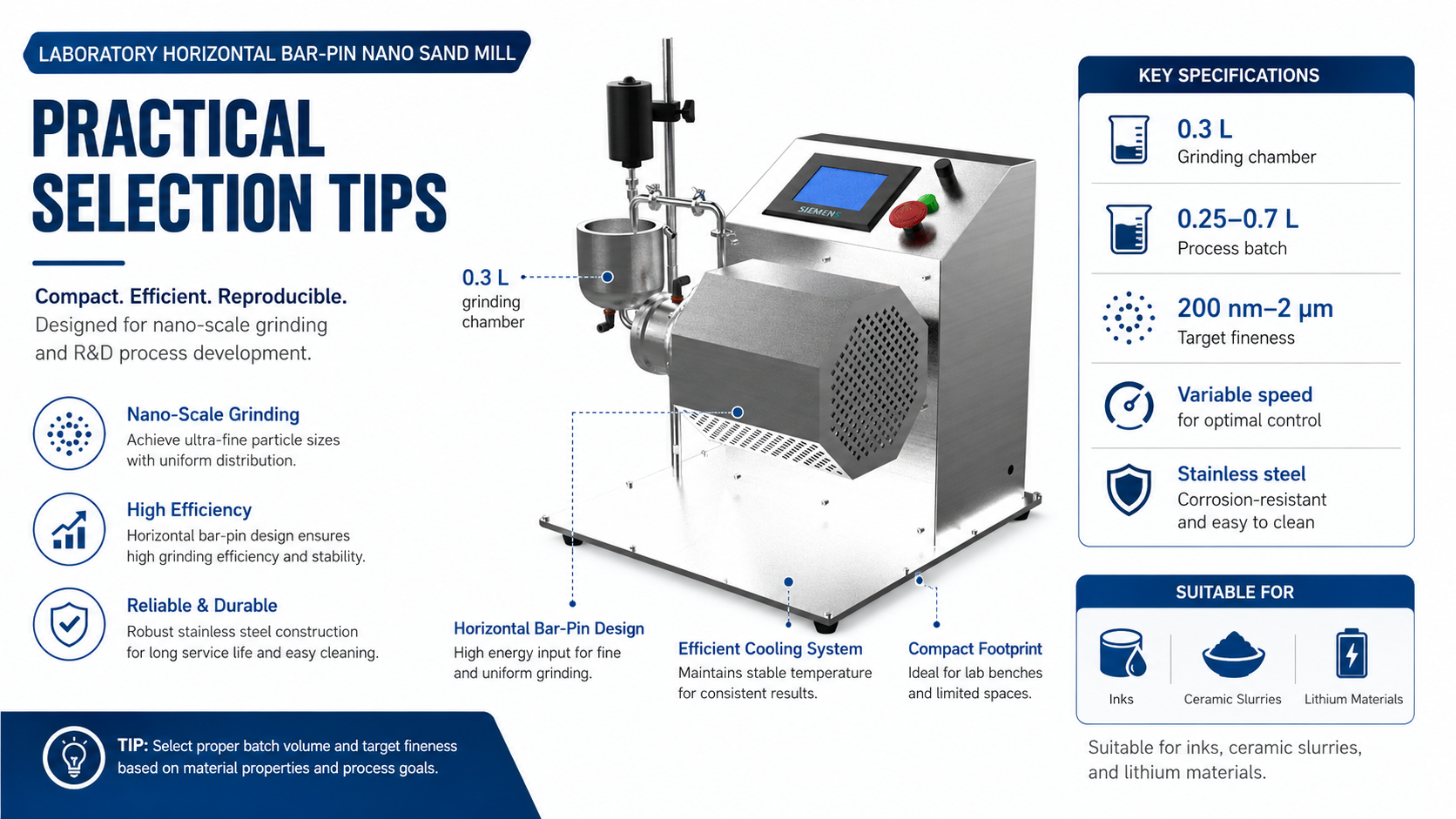
Key Parameters for a Laboratory Horizontal Bar-Pin Nano Sand Mill
When operating a laboratory horizontal bar-pin nano sand mill & Stir Ball Mill , understanding the key process parameters is important for achieving stable and high-quality dispersion results. The equipment performance depends not only on the machine design but also on how operating conditions are adjusted. Small changes in speed, temperature, media, and material properties can affect the final particle size and dispersion quality.
One of the most important parameters is rotor speed. The rotating bar-pin structure creates the grinding force needed to break down particle groups. A higher speed usually creates stronger impact and shear forces, which can help achieve finer particles. However, running at an excessively high speed may generate too much heat and increase wear on the grinding parts. For heat-sensitive materials, such as some battery components or specialty coatings, a suitable speed setting helps maintain material stability.
Grinding media loading is another factor that affects performance. The amount of beads inside the chamber controls how much contact occurs between the media and the slurry. Too little media may reduce grinding efficiency, while too much media can limit material movement and increase energy consumption. The correct filling level allows the beads to move freely while providing enough grinding action.
The size and type of grinding media also influence the final result. Smaller beads are commonly used for nano dispersion because they create more contact points and support finer particle reduction. Larger beads may be more suitable when the starting particles are bigger or harder to break. Selecting the right media should always match the characteristics of the material being processed.
Slurry viscosity and solid content are also important settings. A thick slurry may reduce flow inside the grinding chamber, while a very thin slurry may not provide enough interaction between particles and beads. Before grinding, operators should check the material formula and adjust the liquid-to-solid ratio when needed.
Temperature control should not be overlooked during nano grinding. Continuous high-speed operation creates heat through friction. A cooling system helps keep the slurry at a stable temperature, which is especially important for materials that can change properties when exposed to heat.
For laboratory testing, it is helpful to record each parameter during every trial, including speed, processing time, media size, temperature, and final particle size. This makes it easier to compare results and find the best operating conditions for future experiments or scale-up production.
Table of Contents
- Grinding Chamber Design of a Laboratory Horizontal Bar-Pin Nano Sand Mill
- How a Laboratory Horizontal Bar-Pin Nano Sand Mill Handles Solid-Liquid Slurries
- Laboratory Horizontal Bar-Pin Nano Sand Mill Applications in Battery Materials
- Media Size Selection for a Laboratory Horizontal Bar-Pin Nano Sand Mill
- Key Parameters for a Laboratory Horizontal Bar-Pin Nano Sand Mill

Changsha Tianchuang(TENCAN) Powder Technology Co., Ltd., established in 2006, is an integrated enterprise specializing in R&D, manufacturing, and sales. Its R&D, sales, and operations center is located in the Changsha Economic and Technological Development Zone, while its production base is in the Wushi High-tech Industrial Park.


